Third-Party Patient Financing: The Real Cost Per Case

Finance $360,000 of treatment a year on a 10% merchant plan and you've handed the lender $36,000 before the lab invoice even arrives. Run the identical cases through a 1.9% plan and the bill is $6,840. Same chairs, same clinicians, same patients saying yes. The only variable is which logo is on the brochure in your consult room, and that one decision is worth more to your bottom line than most of the fee-schedule fights you'll pick this year.
Here's the claim an informed owner can argue with: a 10% merchant fee is not a marketing expense, it's a write-off, and you should underwrite it with exactly the same hostility you apply to a PPO contract. Most practice owners file patient financing under "case acceptance" and never look at the line again. That's a category error, and it's costing the average implant-heavy practice two to three points of overhead a year.
$300 vs. $57 on the Same Crown
Start with the per-case number, because that's the only number the front desk sees. Sunbit's dental merchant page advertises a fee "as low as 1.9%," which on a $3,000 case works out to about $57, and it explicitly contrasts that with the 0% APR promotional plans from CareCredit and Cherry, which it says commonly carry merchant fees of 10% or more, or roughly $300 on the same case. That's a vendor's framing of its competitors and you should treat it as such, but the structural point holds and the competitors don't really dispute it.
CareCredit is straightforward that the provider processing fee varies by which promotional option the patient selects, that fees don't vary by the patient's credit score, that there are no annual or monthly provider fees, and that the practice is funded within two business days. All of that is genuinely good. The catch is in the first clause. The fee scales with the promotion, and the promotions that close hard cases are the long ones. CareCredit's own disclosure shows 24-month plans carrying 17.90% APR to the patient if not paid in full, scaling to 20.90% APR at 60 months on purchases over $2,500. The longer and softer the offer looks to the patient, the more it costs you.
So the honest version of "what does financing cost" is not a rate. It's a distribution. Your blended fee is a weighted average of whatever mix of promotional terms your treatment coordinator has been quietly defaulting to for the last eighteen months, and almost nobody reading this knows what that weighted average actually is.
Stack a 10% Fee on a PPO Write-Off and You Are 37% Off
Take a $3,000 treatment plan at your UCR fee. The patient is on a PPO with a 30% adjustment, so your allowed fee is $2,100. They can't cover their portion, so you finance it on a long promotional term at a 10% merchant fee, and the lender funds you $1,890. You've now collected 63% of your posted fee on that case, an effective 37% discount.
Run the same case through a 1.9% plan and you net $2,060, an effective 31.3% discount. The gap on one case is $170.
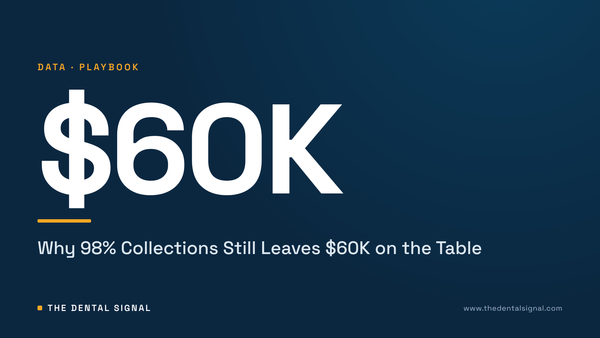
Now scale it. A $1.2M practice that finances $360,000 a year, call it 120 cases averaging $3,000, pays $36,000 at a 10% blended fee and $6,840 at 1.9%. The difference is $29,160. On $1.2M of collections that's 2.4 points of overhead. It is the entire distance between a 60% practice and a 62.4% practice, and it does not appear in a single supply order, wage review or lab negotiation.
We've watched owners spend a full quarter grinding a lab vendor for a 6% concession on $84,000 of crown and bridge, which is $5,040, while leaving five times that on the table in merchant fees.
The 25-Case Break-Even
The defense of the expensive plan is real and you should take it seriously: a lender that approves more patients produces more accepted treatment, and more treatment at a worse fee beats less treatment at a better one. Fine. So price the argument instead of waving at it.
The fee gap is 8.1 points, or $243 on a $3,000 case. Across 120 financed cases that gap costs $29,160. If you treat an incremental case as carrying a 38% margin after all costs, each extra approval contributes $1,140, so the expensive plan has to produce about 25.6 additional cases a year to break even. That's a 21% lift in approvals.
Be generous and argue that an incremental case on an already-staffed schedule carries closer to a 60% contribution margin, because the rent and the salaries are already paid. Now each extra case contributes $1,800 and you need 16.2 of them. That's still a 13.5% lift.
So the test is clean: your expensive lender has to approve somewhere between 13% and 21% more of your declined patients than the cheap one, every year, forever. That is not an impossible bar. It is also not a bar anyone in your practice has ever measured. Our view: if you cannot produce the approval rates for both plans on your own patient population over the last ninety days, you are not paying for approvals, you are paying for inertia.
What Most Owners Get Wrong: The Fee Goes in the Marketing Bucket
The specific mistake, and it is almost always made by the owner rather than the office manager, is booking merchant fees as a cost of acquisition rather than a reduction in collected fee. Once it sits in marketing, it gets judged against a marketing standard: did it bring in cases? Yes? Then it worked. Nobody asks what the same cases would have cost through a different door.
Booked correctly, the fee is a discount off your fee schedule, and it behaves exactly like a PPO adjustment with three differences. It is not credentialed, so you can change it in a week instead of a year. It applies on top of whatever network adjustment you've already eaten. And unlike a PPO, it brings no patient flow of its own, because the patient was already sitting in your chair when the brochure came out of the drawer.
The second-order mistake is letting the treatment coordinator own the promotional term. Nobody at the front desk is incentivized to quote the 12-month plan when the 60-month plan makes the case close faster and the fee lands on a line item they never see. That's not a character flaw, it's a design flaw, and it's yours to fix.
Term Creep Is Erosion, Not Drift
This is where our Drift vs. Erosion test earns its keep. A blended merchant fee that wanders from 6.8% to 7.1% over a year because of case mix is drift: small, reversible, manageable with a conversation. A blended fee that climbs from 6% to 10% because the default offer in your consult room has quietly migrated from 12 months to 60 months is erosion. It compounds, it tracks your case size upward, and it does not reverse on its own, because every quarter the coordinator learns again that the long term closes faster.
Erosion requires renegotiation or exit, not coaching. Treating it as drift, which is what "let's keep an eye on that" amounts to, is the expensive mistake, and it's expensive precisely because the fee is invisible: it never arrives as an invoice, it arrives as money that simply doesn't show up in the deposit.
Your Patient's 26.99% Eventually Becomes Your Problem
There's a second cost that never lands on the merchant statement. Deferred-interest products are the backbone of this category, and the arithmetic is unforgiving to patients who miss the promotional window. When the CFPB and the New York Attorney General acted against GE/CareCredit in 2013, they found that roughly 85% of borrowers were enrolled in deferred-interest plans carrying 26.99% annual interest if the balance wasn't paid in full within the promotional period, and ordered $34.1 million refunded to more than 1.2 million cardholders. The enrollment largely happened at provider counters, and the providers were disproportionately dental.
This is not ancient history. The CFPB's 2023 review found that between 2018 and 2020, patients put almost $23 billion of healthcare expenses on deferred-interest medical cards and installment loans across more than 17 million purchases, and paid $1 billion in deferred interest, with card rates averaging 26.99% against about 16% for installment loans.
Dental is not a bystander in this market, it's the anchor tenant. The GAO counted 4.4 million CareCredit cardholders and 177,000 participating providers, the majority of them dental offices. Your practice is where this product is sold.
The operational consequence is simple. A patient who gets surprised by a retroactive interest charge thirteen months after an implant does not blame the bank. They blame the office that handed them the application. That shows up as a lost recall, a lost family, and occasionally a review that costs more than the case produced. We'd rather close at a 1.9% fee on a plain-vanilla installment loan at a disclosed fixed rate than at 10% on a product that can detonate in the patient's lap next spring.
Run a Waterfall, Not a Marriage
Our call: no practice should be single-lender. Put the cheap, wide-approval installment product first on every case. Send only the declines to the expensive promotional card, which is what it's actually good at. You capture the 1.9% economics on the bulk of your volume and pay the 10% toll only on the cases you'd otherwise lose entirely. If your current vendor's contract forbids presenting a competitor first, that clause is worth more than the fee, and we wouldn't sign it again.
Cap the promotional term you'll offer by default. If 24 months closes the case, nobody needs to be shown 60. Set the longest term as an exception the owner approves, not a button the coordinator presses.
Four Moves Before Friday
Pull your last twelve months of merchant statements and compute one number: total financing fees divided by total financed production. That is your blended rate, and if it's above 6% you have a structural problem, not a vendor-relations problem. Then pull approval counts and decline counts by lender for the last ninety days, because without those the 13% to 21% break-even test is unanswerable. Add a second lender this month and route every case to the cheaper product first. Finally, write down the maximum promotional term your team may offer without asking you, and tell them today.
Merchant fees belong in your overhead stack, not your marketing budget, and two points of overhead is the difference between a practice that sells and one that lingers. If you want to see where your financing costs sit against the rest of your cost structure, run your own numbers through our free overhead calculator and enter your financing fees as the separate line they deserve to be.
What would change our mind: hard evidence that the expensive promotional products really do convert 20% more of the same declined patients, measured in the same practice over the same quarter rather than in a vendor case study. We're collecting blended-rate and approval data from practices running two lenders side by side, and if the approval gap turns out to be that wide, the 10% fee is defensible and we'll say so in print. Until someone shows us that number, it isn't.